CASE STUDY
In the saturated world of quick-service coffee, mere competence won’t cut it. Any cafe can brew a decent latte. Yet, Starbucks doesn’t just sell coffee; they sell a reliable daily ritual. Their dominance isn’t built on the bean alone; it’s constructed on a near-impenetrable fortress of customer loyalty, turning casual buyers into devoted brand evangelists.

For executives studying retention, Starbucks offers a compelling blueprint. They moved beyond simple punch cards to weave their brand into the fabric of the customer’s digital and physical life. It’s a masterclass in combining behavioral psychology with cutting-edge technology.
1. The Loyalty Program as a Financial Ecosystem
The My Starbucks Rewards program is arguably the most powerful tool in their arsenal. But its brilliance lies in its design as a closed, profitable ecosystem, not just a discount scheme.
The Pre-Load Advantage
Starbucks incentivizes customers to load cash onto the app before they ever step foot in a store. Why is this genius?

- Behavioral Lock-In: Once money is loaded, it is effectively trapped capital, making the customer far more likely to choose Starbucks over a competitor to use up their balance.
- Interest-Free Loan: This float—the billions of dollars customers pre-load—acts as an interest-free loan to the company, providing massive working capital.
- The Gamification of Stars: The reward system is structured to encourage larger purchases. Customers earn “Stars,” not points, and rewards are structured to push transactions toward specific amounts or product tiers, subtly increasing the Average Transaction Value (ATV).
2. The Third Place: Engineering the Physical Experience

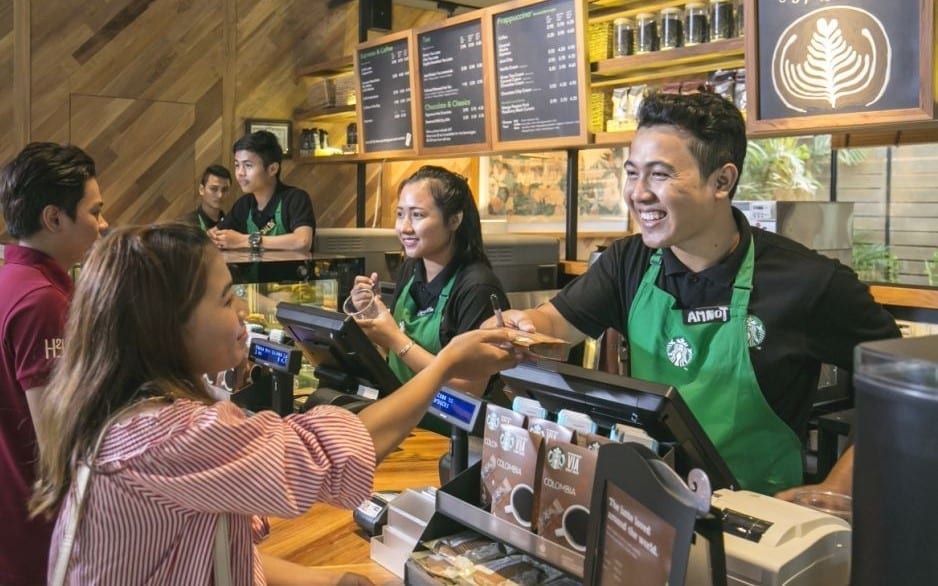
Before Starbucks conquered digital, it conquered the physical space. Founder Howard Schultz famously designed the stores to be the “Third Place”—neither home nor work, but a comfortable, aspirational sanctuary.
They perfected the sensory details that foster returning behavior: the signature espresso aroma, the warm, low lighting, and the reliable, ubiquitous Wi-Fi. It’s a space where customers feel permission to linger, work, or meet.
In an era where remote work is prevalent, this consistent, intentional atmosphere acts as a subtle gravitational pull. Customers aren’t just coming for the drink; they’re coming for the guaranteed environment.
3. Digital Personalization and Predictive Power
Starbucks treats its app as a sophisticated machine learning engine, far more complex than a basic digital wallet. Every scan, every purchase, and every skipped offer feeds the system, allowing for unparalleled personalization.
The Art of the Perfect Offer
The app doesn’t just offer random discounts; it knows exactly what you might buy next. If you regularly purchase a plain latte, the algorithm might push a limited-time offer on a new syrup flavour, prompting an incremental spend. If you haven’t visited in a while, it might send a specific discount on your historical favourite drink to nudge you back through the door. This isn’t mass marketing; it’s one-to-one digital nudging.
Mobile Order & Pay: Eliminating the Friction
By allowing customers to order and pay before they arrive, Starbucks demolished the single greatest deterrent to repeat business: the queue. This process enhances customer returning behavior by offering a seamless experience, especially for busy commuters. It tells the customer, “Your time is valuable, and we are built for speed.” It turns a five-minute wait into a five-second pickup, transforming transactional convenience into habitual use.
Key Takeaway for Executives
The Starbucks model proves that modern loyalty is less about giving away freebies and more about enhancing convenience and earning behavioral data. They don’t just reward transactions; they reward engagement with the entire brand ecosystem—physical, digital, and financial.
The challenge for other brands is to ask: Are we simply rewarding a purchase, or are we intentionally designing a system that makes choosing our competitor inconvenient, slow, or financially illogical? Starbucks has built a moat around its customers, and it is paved with Stars and seamless convenience.
What is one aspect of the Starbucks rewards system that you think would face the biggest challenge being adopted by a Malaysian-based retail brand?