

In a major regulatory intervention, Bank Negara Malaysia (BNM) has overhauled the operational architecture of the nation’s premier specialized lenders. Effective June 24, 2026, the central bank has enacted three synchronized policy documents targeting prescribed Development Financial Institutions (DFIs): the Performance Measurement Framework (PMF), the Corporate Strategic Plan (CSP), and an updated Corporate Governance mandate.
For corporate leaders across Malaysia’s financial services, micro-enterprise, and industrial sectors, this regulatory tightening fundamentally rewrites how public-mandated capital will be deployed, audited, and secured moving forward.
Shifting Focus from Volume to “Additionality”
Historically, standard commercial metrics like loan dispersion volumes and asset portfolio growth dominated corporate banking goals. Under BNM’s newly codified PMF, six major state-backed entities will be subjected to a highly sophisticated system that prioritizes structural socio-economic impacts over baseline commercial yields.
Affected Prescribed DFIs,
- Bank Rakyat (Bank Kerjasama Rakyat Malaysia Bhd)
- Bank Pembangunan Malaysia Bhd
- Agrobank (Bank Pertanian Malaysia Bhd)
- Bank Simpanan Nasional (BSN)
- Exim Bank (Export-Import Bank of Malaysia Berhad)
- SME Bank (Small Medium Enterprise Development Bank Malaysia Berhad)
At the core of the new mandates is the concept of financial additionality. DFIs are now legally required to demonstrate that their funding actively addresses structural financing gaps by supporting high-risk, pioneering, or underserved segments—such as rural agricultural technology, green infrastructure, or volatile export markets—that conventional commercial banks routinely reject.
The Tripartite Framework: A Deeper Strategic Look
The three policy documents function as a single, unified regulatory apparatus designed to enforce a development-oriented corporate culture across all levels of management.
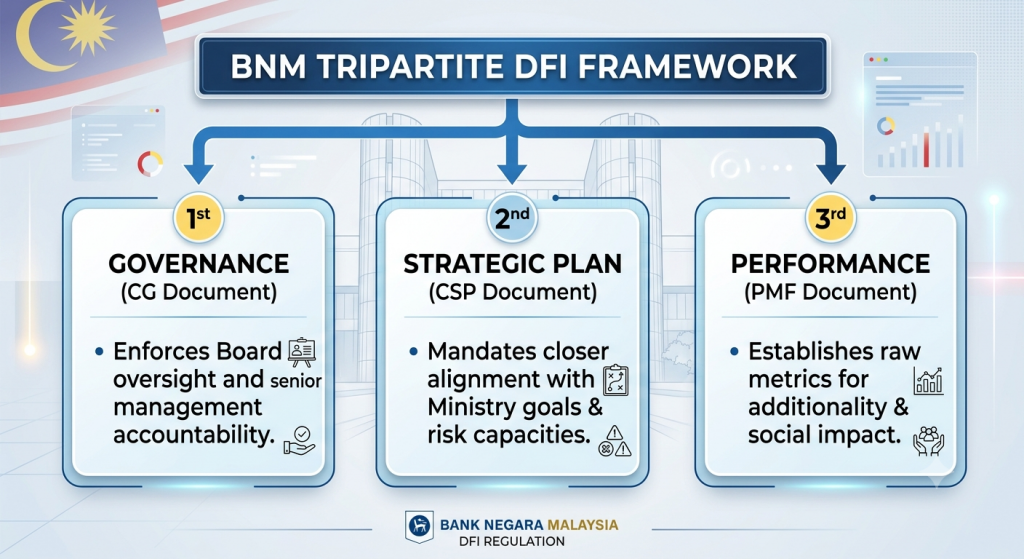
1. Corporate Governance – Enforcing “Tone from the Top”
Superseding the framework established in February 2024, this policy document demands that DFI boards exercise strict strategic oversight regarding how well their institutions fulfill their foundational mandates. The rule removes ambiguity around executive culpability, linking senior management incentive structures directly to verified developmental performance rather than simple profitability.
2. Corporate Strategic Plan (CSP)- Operationalizing the Mandate
Replacing the older May 2021 guidelines, the revised CSP enforces a highly disciplined approach to long-term planning. DFIs must tightly link their strategic execution to rigorous risk management frameworks and baseline funding capacities. Furthermore, it mandates continuous, structured engagement with stakeholder ministries to ensure that corporate actions perfectly match Malaysia’s broad economic policies.
3. Performance Measurement Framework (PMF) – Data-Driven Accountability
This new document establishes the actual metrics for assessing social impact and operational efficiency. Critically, it forces DFIs to upgrade their internal data ecosystems and information infrastructures. Under the PMF, these institutions must systematically track, analyze, and publicly disclose granular developmental data, shifting their staff mindsets from transactional service delivery to long-term economic stewardship.
The Strategic Takeaway for Malaysian CEOs
For corporate executives outside the immediate banking sector, this regulatory shift serves as an important leading indicator.
First, the era of DFIs functioning as passive, low-interest alternatives to commercial banks is over. Businesses seeking capital from institutions like SME Bank, Agrobank, or Bank Pembangunan must now clearly demonstrate how their corporate initiatives generate measurable, long-term socio-economic value.
Second, by forcing an institutional shift toward financial additionality, the central bank is clearing the way for funding in higher-risk sectors. Organizations spearheading innovations in financial inclusion, rural digitization, or sustainable supply chains will find highly receptive partners in these restructured public institutions.
Ultimately, BNM is legally aligning public capital with national intent—demanding that state-backed lenders prioritize long-term economic resilience over near-term commercial profits.