
For years, a persistent structural challenge has defined Malaysia’s economic narrative. The nation has historically participated in global value chains without capturing the highest-margin activities—leaving intellectual property, advanced engineering talent, and core research and development concentrated elsewhere. While entering 2026 with a strong 5.2% GDP growth, a best-performing ringgit, and a rising KLCI index reflects near-term resilience, current performance does not guarantee future competitiveness.
The critical corporate and national question is no longer how to generate short-term growth, but how to deploy capital to build enduring national capability.
The strategy to bridge this gap is found in GEAR-uP. Orchestrated by the Ministry of Finance, this initiative represents a disciplined, coordinated evolution in how institutional capital is mobilized across the domestic economy.
The Architecture of Patient Capital
Instead of channeling funds through the standard fiscal budget, GEAR-uP mobilizes RM120 billion in domestic direct investments over five years directly from the balance sheets of six government-linked investment companies (GLICs) ,EPF, PNB, KWAP, Khazanah Nasional, Lembaga Tabung Haji, and LTAT.
This creates a formidable pool of “patient capital”. This capital is uniquely positioned to absorb market risk, support long-term capability-building, and maintain continuity through multiple economic cycles. The objective is simple: invest where public policy priorities and long-term commercial returns are mutually reinforcing.
A Lifecycle Approach to Economic Development
To build a competitive next economy, institutional capital must cover every stage of the business lifecycle. GEAR-uP achieves this through a coordinated trio of operational mandates:
1. Innovation and Frontier Tech Ecosystems (Khazanah)
Khazanah’s RM6 billion Dana Impak allocation anchors the earliest stages of the pipeline. Through Jelawang Capital, capital is routed to emerging Malaysian fund managers to seed disruptive startups like Aonic and DF Automation. Simultaneously, direct investments into deep-tech players like SkyeChip and semiconductor pioneer Syntiant embed advanced AI chip design and high-tech R&D facilities directly into the domestic industrial base.
2. Deepening Private Market Infrastructure (KWAP)
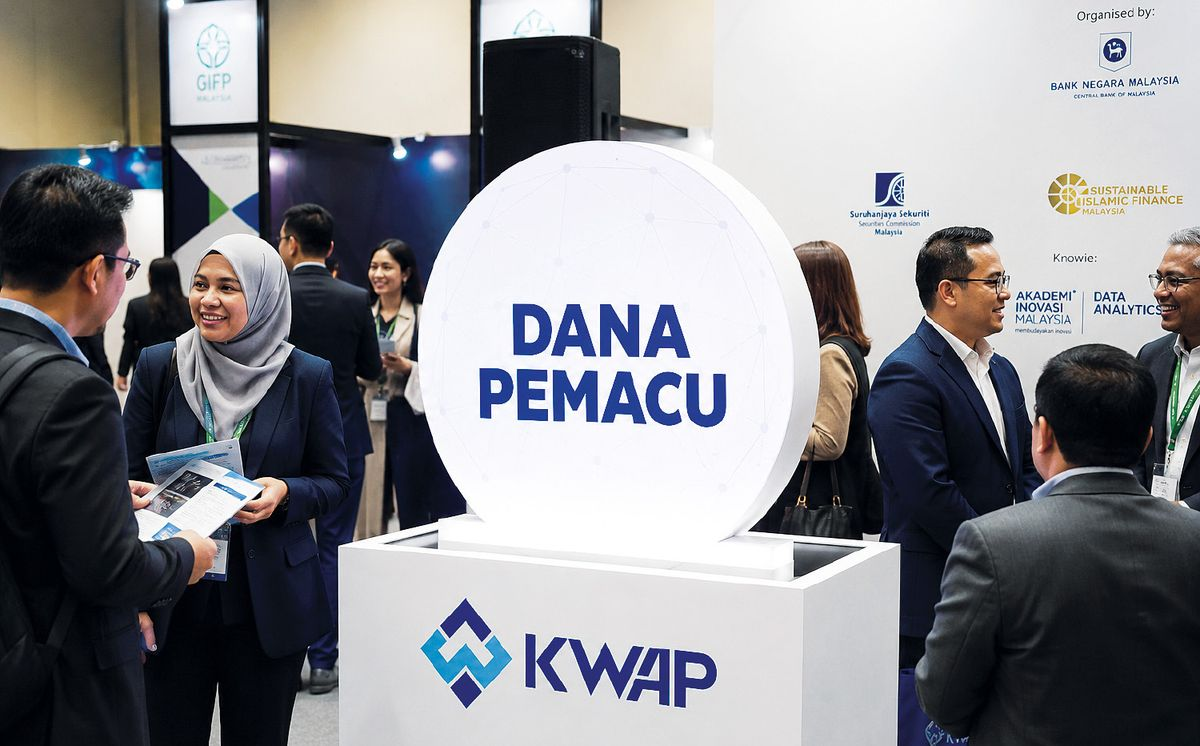
KWAP acts as the bridge for growth-stage entities by strengthening capital infrastructure. Its RM6 billion Dana Pemacu uses a Co-General Partner (co-GP) model, pairing global private market managers with local talent to embed international institutional expertise into the domestic market. This infrastructure pipeline is already deploying capital into vital data centers, renewable energy assets, and logistics networks.
3. Public Market Maturity and Citizen Wealth (PNB)
PNB completes the economic cycle by taking mature, privately incubated enterprises to the public markets. The trajectory of Orkim Berhad—scaling from private equity ownership under Ekuinas to a Main Market IPO in 2025—demonstrates this model perfectly. The IPO generated substantial proceeds, returning RM350 million in dividends to PNB to flow straight back to everyday unitholders. Corporate value creation is thus directly converted into community financial well-being.
The Execution Mandate
Corporate ambition means very little without the underlying machinery to deliver it. While full economic transformation requires multiple cycles, the early execution phase of GEAR-uP proves that a coordinated system of institutional capital can systematically move startups to scale, mid-tier companies to regional prominence, and domestic enterprises to public market maturity.
The foundations are being laid. Moving forward, the focus must remain entirely on execution discipline, ensuring that this RM120 billion commitment builds the sovereign technology, infrastructure, and industrial advantages Malaysia requires to lead the region.