

Ambitious corporate strategy is never in short supply among business leaders in Malaysia; however, the organizational machinery required to deliver it frequently is.
Data from the Bain CEO Survey 2026 and PwC’s 29th Global CEO Survey highlights a sharp reality check for the market: a mere 33% of CEOs in Malaysia feel highly confident about their company’s revenue growth over the next 12 months. This marks a steep, double-digit decline from previous periods. Compounding this anxiety, 41% of leaders openly question whether current strategic paths do enough to safeguard long-term corporate viability.
The core issue does not lie in a lack of vision. Instead, a widening chasm separates boardroom strategy from frontline execution.
The Reality of the Strategy-Execution Paradox
Fewer than half of all chief executives believe their organizations possess the agility to adapt and execute under volatile market conditions. Instead, strategic intent is routinely choked by corporate bureaucracy, sluggish governance frameworks, and a distinct shortage of entrepreneurial behavior on the frontline.
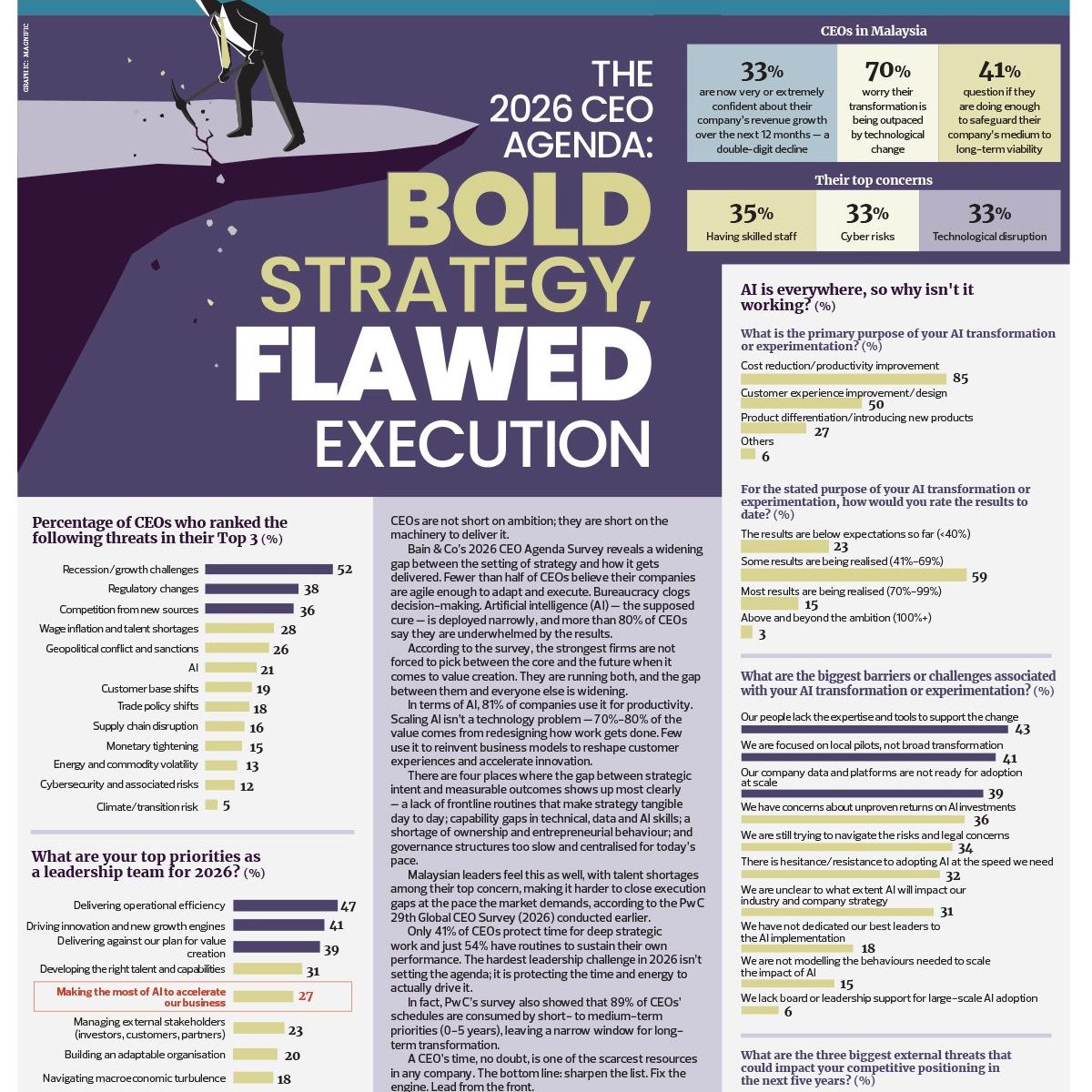
An analysis of executive time allocation and operational friction points reveals a clear systemic breakdown,
- The Short-Term Time Trap – An overwhelming 89% of CEO schedules are entirely consumed by short- to medium-term operational priorities (0–5 years). This leaves a dangerously narrow window to architect true, long-term structural transformation.
- The Talent Deficit – Securing and retaining skilled staff ranks as the top operational concern for corporate leaders at 35%, directly crippling the ability to close performance gaps at the pace the market demands.
- The Decision Bottleneck – When identifying organizational behaviors that must be reduced, 35% of respondents pointed directly to slow decision-making, excessive bureaucracy, and a deep-seated resistance to change.
The AI Underachievement: Moving Past “Pilot Syndrome”
This execution gap is exceptionally visible in corporate artificial intelligence (AI) deployments. AI occupies a permanent spot on the executive agenda, yet it remains fundamentally underutilized.
While 85% of enterprises deploy AI to drive cost reduction and basic productivity improvements, more than 80% of CEOs report being underwhelmed by the actual returns. Currently, 23% of implementations are tracking significantly below initial expectations.
The transition from localized experimentation to enterprise-wide value creation is blocked by three distinct operational hurdles,
- The Skill Gap– 43% of organizations lack the internal expertise and essential tools required to support and manage technological change.
- Pilot Syndrome– 41% of companies remain stuck in localized, fragmented pilots rather than committing to broad business model innovation.
- Infrastructure Deficits– 39% of leaders admit that underlying company data and platforms are simply not mature enough for large-scale AI adoption.
The Executive Mandate- Fix the Engine
The most successful firms in this environment do not force a choice between optimizing the core business today and inventing the future; they run both priorities concurrently.
To bridge the execution gap, leadership focus must pivot away from rewriting strategy decks toward sharpening the organizational engine,
- Dismantle Bureaucracy – Centralized governance structures must be minimized. Replacing them with clear frontline accountability accelerates daily decision-making speed and eliminates institutional resistance to change.
- Insulate Strategic Time – Executive calendars require an aggressive audit. Leaders must deliberately protect and insulate deep, uninterrupted blocks of time to design long-term competitive positioning rather than succumbing to short-term firefighting.
- Commit to Scale– AI cannot continue to live as a marginal productivity experiment. Companies must holistically redesign workflows, upgrade legacy data infrastructure, and upskill teams to capture real, enterprise-wide value.
Ambition without execution is merely noise. Navigating a volatile macroeconomic climate requires corporate leaders to spend less time polishing strategic concepts, and far more time sharpening the machinery that delivers them.