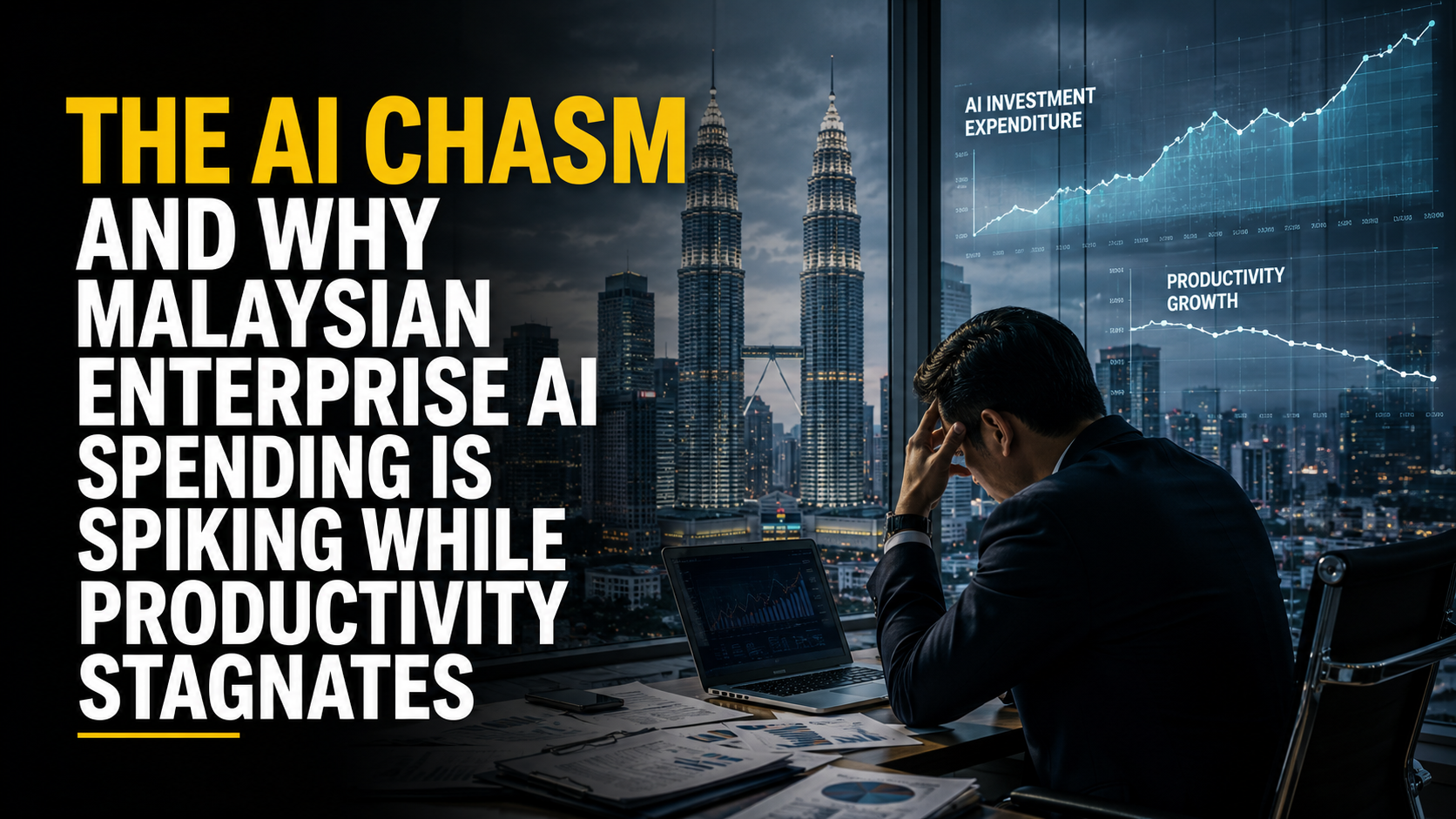
Budgets are locked in for the current financial cycle, and the corporate mandate across Kuala Lumpur and Johor is uniform: invest heavily in artificial intelligence. This momentum is supercharged by the government’s fiscal commitments, including major funding for Sovereign AI Clouds and tax deductions for enterprise AI training.
Yet, behind closed boardroom doors, a frustrating contradiction is emerging. CEOs are greenlighting multi-million ringgit software deployments, but the expected leaps in bottom-line operational efficiency are stalling.
This is the AI Productivity Paradox. While internal indicators show high initial tool adoption—with data showing up to 93% of knowledge workers experimenting with generative AI—internal corporate audits paint a concerning picture. Employees report that their workloads have actually increased since AI deployment, middle managers are bogged down in fragmented oversight, and projects are trapped in a state of perpetual piloting.
Malaysian enterprises have crossed the initial adoption hurdle; they are now facing the AI Chasm. To bridge this gap and convert high capital expenditure into actual productivity, corporate leaders must move past standard software provisioning and re-engineer the fundamental architecture of work.

The Trap of Paving the Cow Path
The primary reason enterprise AI spending fails to deliver a measurable return on investment is a flawed implementation framework. Most organizations treat AI as an isolated software upgrade—plugging a powerful tool directly into an inefficient, legacy process.
If a workflow requires six layers of fragmented email handoffs, manual data verification, and duplicate approvals, handing the team an AI assistant will not fix the underlying bottleneck. It will simply create a scenario where bad data is generated at a much faster velocity, overwhelming middle management.
To break this loop, CEOs must enforce an automated workflow redesign. Corporate transformation heads must visually map out the target business process from start to finish, isolate the precise areas where delays happen, and strip away unnecessary administrative steps entirely before automating the process. AI should be embedded as a native infrastructure element that eliminates the step, rather than a sidecar tool that just helps an employee do a broken step faster.

Overcoming the Augmented Divide in Middle Management
True enterprise transformation lives or dies in the middle management layer. While executive boards look at AI through the lens of strategic efficiency, and junior staff use it to speed up localized tasks, middle managers are caught in a severe bottleneck.
Without explicit workflow frameworks, managers are suddenly forced to review massive influxes of AI-generated reports, code, and copy, leaving them with less time to focus on core strategic execution.
This widening operational chasm separates augmented teams from unaugmented teams. To bridge this divide, leadership must shift training budgets away from generic tool literacy to specific workflow orchestration. Stop training your workforce simply on how to write a prompt. Instead, train your managers on how to build data verification guardrails, design strict AI handoff protocols, and transition their leadership style from passive task-monitoring to active system orchestration.

Shifting KPIs from Activity Metrics to Outcome Value
When tracking the success of a technology rollout, many corporate dashboards rely heavily on vanity metrics such as license activation rates or the volume of content generated. In an AI-driven economy, activity does not equal productivity. Generating a higher volume of standard documentation adds zero commercial value to your enterprise if it doesn’t compress project cycle times or increase client retention.
C-suite leaders must ruthlessly recalibrate their key performance indicators to prioritize outcome value. This means tracking time-to-market compression to measure whether the AI integration has shortened the timeline from product conception to commercial launch.
It means measuring error-rate reduction in high-stakes environments like finance and legal compliance. Finally, it requires evaluating capacity expansion revenue—ensuring that the hours saved by automation are being successfully reinvested by your team into high-margin activities like direct client acquisition.
The C-Suite AI Action Checklist
| Diagnostic Focus | Critical Warning Sign | Strategic Action Item |
| Workflow Architecture | AI tools are being used as a side-car to legacy manual processes | Enforce a process-first audit to eliminate administrative steps before automation |
| Management Capability | Managers are overwhelmed reviewing an absolute flood of unfiltered AI drafts | Pivot corporate training to focus strictly on workflow orchestration and data guardrails |
| Performance Tracking | Enterprise dashboards are tracking license activation rather than financial ROI | Drop vanity activity metrics and tie AI success directly to project speed and freed-up capacity |