Johor Corporation just released its audited financial results, showing group profit after tax more than doubled to RM703 million. Backing this surge is a 10% revenue expansion reaching RM7.63 billion, alongside a 45% jump in pre-tax profit past the RM1 billion threshold. This performance solidifies the investment group’s balance sheet, pushing net assets to RM12.21 billion while scaling total assets under management close to RM30 billion.
For conglomerate directors, family office investors, and diversified holding executives, this turnaround is a highly relevant strategic blueprint. Managing a multi-sector corporate portfolio during macro volatility frequently results in capital stagnation, where underperforming legacy units drain liquidity from high-growth divisions.
JCorp’s massive profitability jump demonstrates the clear value of aggressive, structured asset optimization. Rather than relying on simple, passive cross-subsidization, leadership executed strict corporate restructuring to position its core business lines directly inside high-margin economic corridors. For C-suite leaders navigating diversified operations, this success highlights exactly how to ruthlessly deploy capital to maximize enterprise value.
Prioritizing Defensive Core Sectors to Insulate Group Revenue Lines
The foundational driver behind the earnings surge was the deliberate scaling of recession-proof business units. Within a highly diversified conglomerate, trying to chase high-risk, volatile market segments can easily destabilize group cash flow during economic downturns.
JCorp tightly anchored its portfolio around its largest revenue engine: healthcare and wellness via KPJ Healthcare Berhad. The medical division alone contributed a record RM4.26 billion to group revenue, driven by a sharp rise in inpatient, outpatient, and surgical activities across its healthcare network.
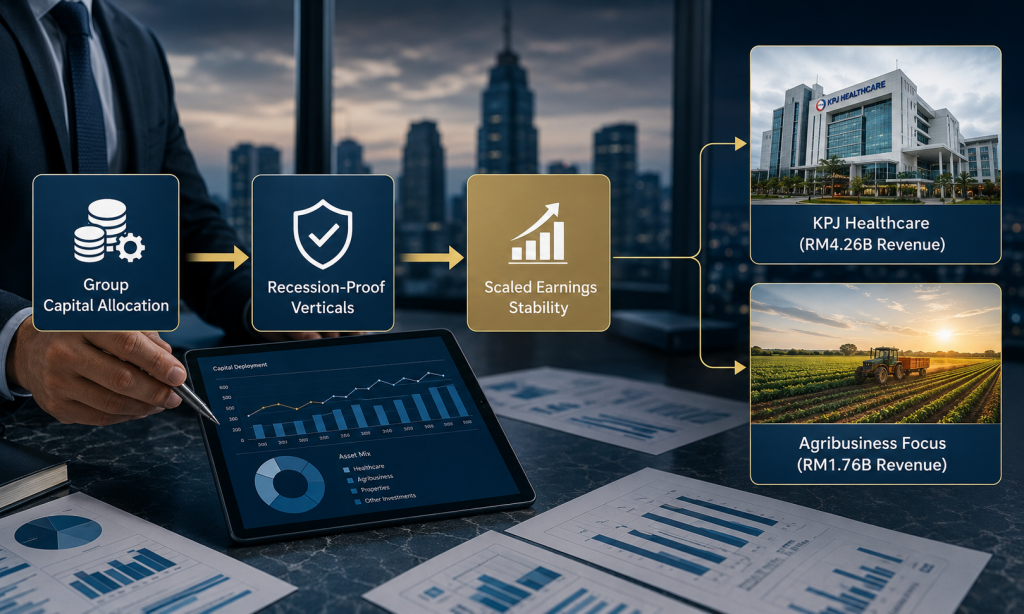
Simultaneously, the group maximized its agribusiness segment—led by Kulim Berhad and Johor Plantations Group Berhad, pushing its vertical revenue to RM1.76 billion through advanced operational streamlining and favorable commodity pricing. By funneling capital into verified, high-demand operational sectors rather than speculative projects, holding companies can build a highly resilient financial floor capable of weathering broader macro shifts.

Enforcing De-leveraging Frameworks to Enhance Corporate Financial Flexibility
A common pitfall for large-scale enterprise portfolios is the accumulation of expensive, uncoordinated structural debt across separate subsidiaries. High leverage quickly eats away at net margins, leaving the parent organization with limited free cash flow to deploy toward fresh investment opportunities.
The financial turnaround team aggressively addressed portfolio leverage by improving its gross gearing ratio down to 0.75 times. This disciplined balance sheet management directly enabled cash and cash equivalents to rise to a robust RM2.77 billion.
By actively pairing internal cost management with structured debt reduction plans, the holding company successfully lowered its overall group financing costs. This optimized capital profile ensures that the enterprise maintains extreme financial agility, allowing leadership to self-fund major new infrastructure rollouts without relying on high-interest commercial bank loans.
Transforming Industrial Real Estate to Capture Regional Capital Inflows
Beyond traditional healthcare and agribusiness operations, modern portfolio optimization requires the rapid monetization of physical assets. Stagnant property landbanks represent a massive drag on a conglomerate’s return on equity if left uncultivated.
The group successfully extracted massive asset value through its real estate division, JLand Group, which grew its revenue by 28% to RM1.33 billion. This was achieved by transitioning legacy industrial landbanks into highly specialized industrial complexes optimized for incoming foreign direct investment.
By strategically aligning real estate offerings with regional development blueprints—such as specialized hubs for advanced manufacturing and tech infrastructure—holding companies can rapidly convert raw land assets into highly recurring dividend pipelines and immediate industrial land sale profits.